Client: U.S. Department of State (Biden Administration)
Agency: Freeman
Following the success of Year 1, the State Department returned to Freeman for the second Summit for Democracy. This time with more added complexity. The event would span two days with distinctly different formats: Day 1 would replicate the global virtual broadcast with 100+ world leaders, while Day 2 would introduce an entirely new element—a 1,500-person in-person general session featuring the Secretary of State, U.S. senators, and private sector leaders.
GXP’s Role: Executive Producer
For Year 2, we stepped into the executive producer role, overseeing the entire two-day show production. This meant leading our team and client through all aspects of show flow, optimizing operations based on Year 1 learnings, and ensuring flawless execution across both the virtual and in-person environments. In an ideal scenario, this scope would have been staffed with individual show producers for each day reporting to an EP—but the reality of government timelines and evolving scope meant one person carried the full weight of the show production.
Day 1: The Virtual Global Broadcast (Refined)
We returned to the same technical foundation as Year 1—master control at the Washington Convention Center with a direct feed to and from the South Court Auditorium at the White House, where the President delivered remarks. But we implemented significant operational improvements:
Optimizing Producer Workflow:
Year 1 revealed an inefficiency: if each virtual producer had four presenters appearing sequentially in the rundown, they’d be fully occupied during that block while other producers sat idle waiting for their segment. For Year 2, we staggered assignments—Producer 1 handled presenters 1, 5, 9, and 14; Producer 2 handled 2, 6, 10, and so on. This distributed the workload evenly and kept our entire team actively engaged throughout the broadcast.
Elevating the Presenter Experience:
Year 1 relied on technicians monitoring equipment with virtual producers overseeing them. For Year 2, we replaced technicians with technically savvy producers in those operator chairs. This shift brought white-glove service directly to the world leaders joining our broadcast—no intermediary, just experienced producers who could handle both technical troubleshooting and diplomatic communication seamlessly.
Strategic Use of Pre-Recorded Content:
We integrated pre-recorded segments—ranging from 60 seconds to 5 minutes—as intentional transitions between live sessions. These included commitment announcements from the private sector, messages of support from international leaders, and even children sharing their definitions of democracy. This content served as both palate cleansers and strategic reset moments, allowing us to transition smoothly between sessions while maintaining audience engagement.
Refined Show Flow:
Working closely with the State Department’s Protocol Officers (who oversee all White House summits), we tightened the rundown based on attention span data and diplomatic protocols. Sessions became more impactful by trimming where possible without sacrificing substance.
The day featured a mix of individual remarks from world leaders and panel discussions, all interpreted simultaneously into 7+ languages and ASL, broadcast live to a global audience.
Day 2: The In-Person General Session (New Territory)
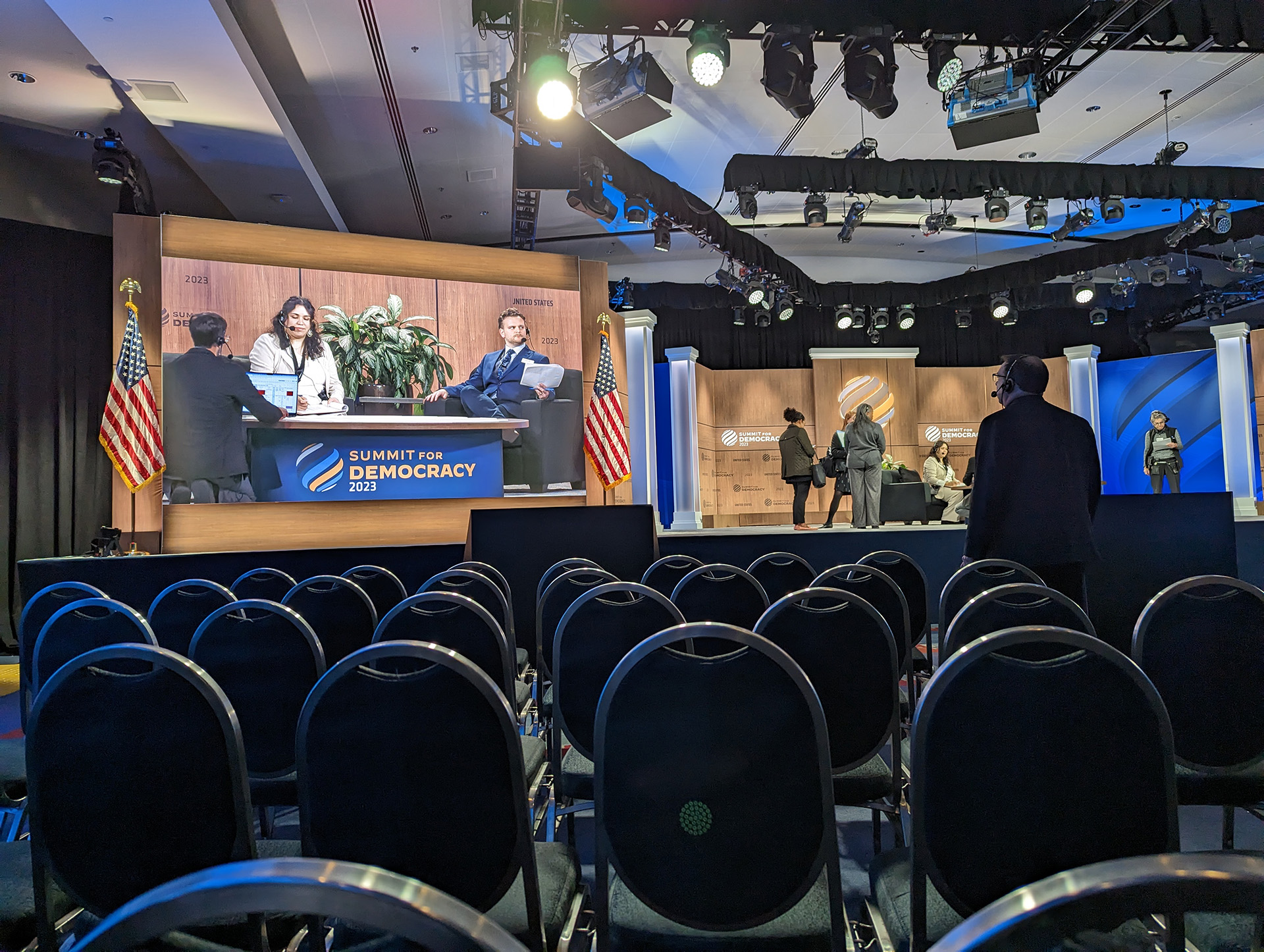
Day 2 was entirely new for the Summit. A full-day in-person event at the Convention Center with approximately 1,500 attendees. Unlike Day 1’s focus on world leaders, this session centered on the private sector’s role in supporting democracy, featuring panels and discussions with the Secretary of State, U.S. senators, and business leaders.
The event was also live-streamed with simultaneous interpretation available to virtual audiences in 7+ languages.
The Challenge Within the Challenge:
In-person diplomatic events operate on a different kind of clock. Schedules are fluid, security protocols are non-negotiable, and VIPs, some literally running countries, operate on their own timelines.
Midway through the day, the Secretary of State left the building for a meeting and ran 20 minutes behind schedule. Our hired host had to stall on stage while we worked directly with the Secretary’s security detail to coordinate his return to close the day. He would be briefed while walking from his vehicle to the stage with no time to stop or reset.
Behind the scenes, our team was rapidly retiming segments, feeding stall remarks to the host, and coordinating with security for a seamless handoff. To the audience, it looked flawless. No one would have known about the controlled chaos happening in the back of house.
The Scale
Across both days, our team managed:
- 100+ world leaders joining virtually from their home countries
- 1,500 in-person attendees
- Master control at the Convention Center with direct White House feed
- Simultaneous interpretation in 7+ languages and ASL
- Live streaming for global audiences
- Real-time program adjustments for diplomatic scheduling
The Impact
The second Summit for Democracy proved that the model could evolve. We didn’t just repeat Year 1—we refined it operationally and expanded it to include a significant in-person component, all while maintaining the diplomatic precision and broadcast quality the State Department required.
At the conclusion of the event, the State Department’s Protocol team insisted GXP be front and center in the team photo. A gesture that spoke to the trust and partnership we’d built over years of unprecedented diplomatic production.
The Biden administration’s Summit for Democracy concluded with Year 2, but the State Department continued working with Freeman on other high-stakes events, confident in our ability to execute under pressure at the highest levels of government.
